
Finding the right study abroad scholarships for Indian students can make international education much more…
Best Courses to Study Abroad After 12th for Indian Students in 2026: Top Countries, Universities and Career Opportunities
Choosing the best courses to study abroad after 12th is an important step towards building a successful career. For Indian students, studying overseas offers access to internationally recognised degrees, specialised academic programmes and practical learning opportunities. However, selecting the right course requires careful planning because tuition fees, admission requirements and career options vary from one country to another.
Whether you have completed Class 12 in Science, Commerce or Arts, several undergraduate programmes are available at universities worldwide. For example, Science students can explore engineering, computer science and healthcare, while Commerce students can consider finance, business administration and economics. Similarly, Arts students can pursue psychology, design, media studies and international relations.
This guide explains the most popular courses, leading study destinations, university options and career opportunities for 2026. You will also learn how to compare programmes and prepare for admission. For personalised assistance, visit Nexa Overseas to explore study abroad guidance and available services.
Why Should You Consider Studying Abroad After 12th?
Studying abroad after Class 12 allows you to begin your undergraduate education in an international academic environment. You can apply directly to an eligible overseas degree programme without completing a bachelor’s degree in India first. However, admission depends on your academic qualifications, chosen subject and the university’s entry requirements.
Here are some important reasons to consider international education after school.
- International qualifications: A recognised overseas degree can support applications for employment and further education, depending on the qualification and employer requirements.
- Specialised courses: Universities offer programmes in artificial intelligence, cybersecurity, biotechnology, business analytics and digital marketing.
- Practical learning: Many programmes include laboratory sessions, industry projects, internships or work placements, depending on the course.
- Career development: A degree that matches your interests can help you develop relevant knowledge and professional skills.
- Flexible academic options: Some universities offer elective subjects, combined degrees and opportunities to specialise during later years of study.
However, an overseas degree does not guarantee employment or permanent residency. Therefore, compare the course curriculum, total expenses, professional recognition and post-study work regulations before making a decision.
For help identifying suitable programmes, explore university and course selection services before preparing your applications.
How Do You Choose the Best Courses to Study Abroad After 12th?
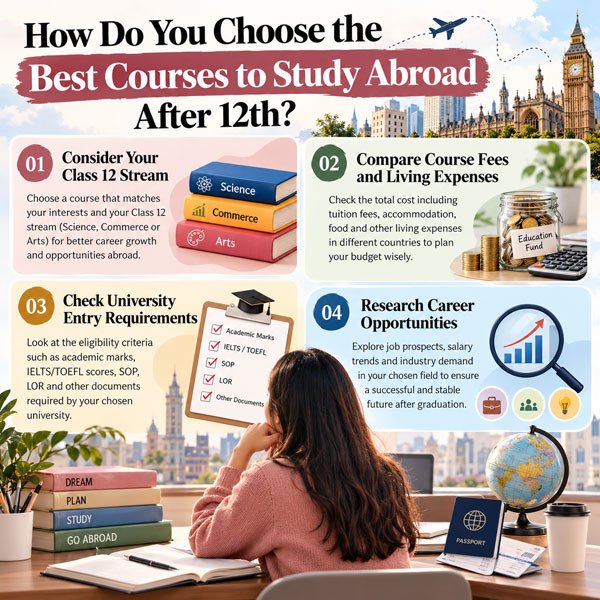
The best course depends on your Class 12 subjects, academic performance, interests, budget and long-term career plans. Rather than choosing a programme only because it is popular, examine the subjects taught, practical training opportunities and qualifications required for your preferred profession. This approach helps you shortlist universities that match your academic profile and financial plans.
1. Consider Your Class 12 Stream
Your school subjects can influence which undergraduate programmes are available to you. For instance, engineering courses commonly require Mathematics and relevant Science subjects. Healthcare programmes often require Biology or other specified subjects, while business and humanities courses may accept students from several academic streams.
2. Compare Course Fees and Living Expenses
Tuition fees are only one part of the total cost. You must also budget for accommodation, food, transport, health insurance, study materials and visa-related expenses. In addition, check whether scholarships are available for international applicants before finalising your university shortlist.
3. Check University Entry Requirements
Universities set their own admission criteria. These may include Class 12 marks, subject prerequisites, English language proficiency tests such as IELTS or TOEFL, entrance examinations, portfolios or personal statements. Consequently, review the official requirements for each programme instead of assuming that one set of qualifications applies everywhere.
4. Research Career Opportunities
Review the roles graduates can pursue after completing a course. For regulated professions such as medicine, nursing and law, check the licensing and professional recognition requirements in the country where you intend to work. You should also examine current employment conditions and applicable post-study work regulations.
What Are the Best Courses to Study Abroad After 12th in 2026?
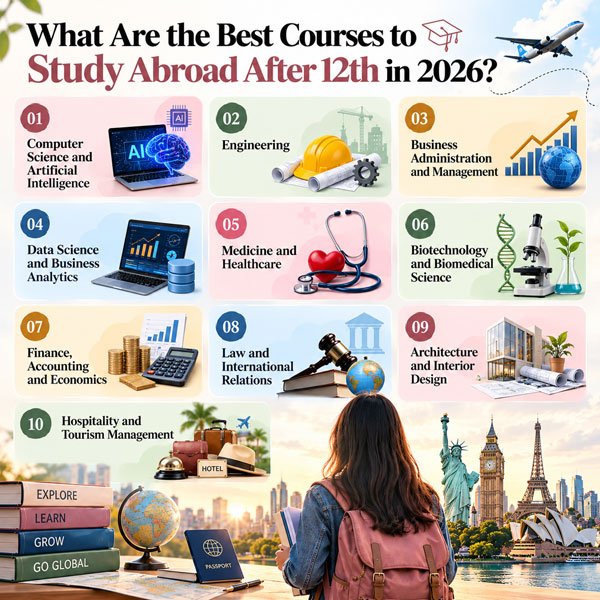
Several undergraduate fields offer different academic and career pathways for Indian students. The following options cover technology, engineering, healthcare, business and creative subjects. Your final choice should depend on your interests, eligibility and the opportunities available at your preferred universities.
1. Computer Science and Artificial Intelligence
Computer Science is a suitable option for students interested in programming, software development, computing systems and emerging technologies. Many universities offer specialised modules in artificial intelligence, machine learning, cloud computing and cybersecurity as part of their undergraduate programmes.
Popular degree options:
- Bachelor of Computer Science
- BSc in Artificial Intelligence
- BSc in Software Engineering
- BSc in Information Technology
- BSc in Cybersecurity
Countries to consider: USA, UK, Canada, Australia, Ireland and Germany.
Career opportunities: Graduates may pursue roles such as software developer, systems analyst, junior cybersecurity analyst or AI-related technology professional, depending on their skills and experience.
This field is worth considering if you enjoy logical thinking, problem-solving and technology. Before applying, compare the programming languages, laboratory facilities, internship options and specialisation modules offered by each university.
2. Engineering
Engineering is another popular choice among students who enjoy Mathematics, Physics and practical problem-solving. International universities offer undergraduate degrees in several specialisations, allowing students to focus on industries such as construction, manufacturing, electronics, energy and software development.
Popular degree options:
- Bachelor of Mechanical Engineering
- Bachelor of Civil Engineering
- Bachelor of Electrical Engineering
- Bachelor of Chemical Engineering
- Bachelor of Mechatronics Engineering
Countries to consider: Germany, USA, UK, Canada and Australia.
Career opportunities: Depending on the specialisation, graduates can explore roles in product design, infrastructure, manufacturing, energy systems, automation and engineering research.
However, admission requirements vary by institution. Many engineering programmes require Mathematics and Physics at Class 12 level. In addition, check whether the degree meets the accreditation requirements relevant to your intended career.
3. Business Administration and Management
Business Administration is a practical choice for students interested in management, marketing, entrepreneurship, finance and organisational strategy. An undergraduate business degree usually introduces core business concepts before allowing students to select electives or a specialised pathway.
Popular degree options:
- Bachelor of Business Administration (BBA)
- BSc in Business Management
- Bachelor of International Business
- Bachelor of Marketing
- Bachelor of Entrepreneurship
Countries to consider: UK, USA, Canada, Australia and Ireland.
Career opportunities: Graduates can pursue entry-level opportunities in marketing, business development, operations, sales, management support and entrepreneurship.
Furthermore, look for programmes that include internships, business projects and industry placements. These opportunities can help you understand how companies operate and apply classroom concepts to practical situations.
4. Data Science and Business Analytics
Data Science combines statistics, programming and analytical methods to interpret information and solve problems. Business Analytics focuses on using data to support business decisions. Both fields can suit students who enjoy Mathematics, technology and structured problem-solving.
Popular degree options:
- BSc in Data Science
- BSc in Business Analytics
- Bachelor of Statistics and Data Analytics
- BSc in Applied Mathematics
Countries to consider: USA, UK, Canada, Australia and Ireland.
Career opportunities: Depending on the programme and technical skills developed, graduates may pursue junior data analyst, business analyst, reporting analyst or related entry-level positions.
Before choosing a programme, examine its Mathematics requirements and practical training in statistics, Python, databases and data visualisation. These skills can provide a useful foundation for further specialisation.
To compare your options and understand the application process, visit Nexa Overseas services for information about available study abroad assistance.
5. Medicine and Healthcare
Medicine and healthcare are popular choices for students interested in human health, medical research and patient care. However, admission to medical programmes is highly competitive, and the entry requirements vary significantly between countries. Students must check subject prerequisites, entrance examinations, course duration and professional licensing rules before applying.
Popular degree options:
- Bachelor of Medicine and Bachelor of Surgery (MBBS or equivalent medical degree)
- Bachelor of Nursing
- Bachelor of Pharmacy
- Bachelor of Physiotherapy
- BSc in Biomedical Science
- BSc in Public Health
Countries to consider: UK, Australia, USA, Canada, Ireland and selected European countries.
Career opportunities: Depending on the degree and professional registration requirements, graduates can explore careers in nursing, pharmaceutical services, biomedical research, public health and other healthcare fields. Becoming a licensed doctor requires completion of the prescribed medical education and registration process in the relevant country.
Before selecting a medical programme abroad, Indian students should also verify the applicable rules of the National Medical Commission (NMC) if they intend to practise medicine in India after graduation. This step helps avoid complications related to degree recognition and eligibility for medical registration.
6. Biotechnology and Biomedical Science
Biotechnology combines biology with technology to develop products and processes used in healthcare, agriculture, pharmaceuticals and environmental science. Biomedical Science focuses on the scientific principles behind human health, diseases and laboratory investigations. Both subjects suit students interested in scientific research and laboratory-based work.
Popular degree options:
- BSc in Biotechnology
- BSc in Biomedical Science
- BSc in Molecular Biology
- BSc in Genetics
- BSc in Microbiology
Countries to consider: USA, UK, Australia, Canada, Germany and Ireland.
Career opportunities: Graduates can explore entry-level roles in laboratory research, biotechnology companies, pharmaceutical organisations, quality control and scientific support. Advanced research positions may require a master’s degree or PhD.
In addition, compare the laboratory facilities, research projects and internship opportunities offered by universities. A programme with practical laboratory training can help you develop skills that are useful for further study and scientific careers.
7. Finance, Accounting and Economics
Finance, Accounting and Economics are suitable options for students interested in money management, financial markets, business performance and economic decision-making. These degrees cover different aspects of the financial sector, so you should select a programme according to your preferred career path.
Popular degree options:
- Bachelor of Finance
- Bachelor of Accounting
- BSc in Economics
- BSc in Banking and Finance
- BSc in Financial Economics
Countries to consider: UK, USA, Canada, Australia, Ireland and Singapore.
Career opportunities: Depending on the degree and additional qualifications, graduates can pursue entry-level roles in accounting, financial analysis, banking operations, business research and financial services.
Furthermore, check whether the course offers industry projects, accounting software training or professional qualification pathways. These features can help you understand the practical requirements of financial careers.
8. Law and International Relations
Law and International Relations offer different pathways for students interested in legal systems, public policy, diplomacy and international affairs. Law degrees prepare students to understand legal principles, while International Relations examines political systems, international cooperation and global issues.
Popular degree options:
- LLB or an equivalent undergraduate law degree
- Bachelor of International Relations
- BA in Political Science
- BA in International Studies
- BSc in Politics and Economics
Countries to consider: UK, Australia, USA, Canada and Ireland.
Career opportunities: Graduates may pursue opportunities in legal support, policy research, public affairs, international organisations and government-related research. Practising law requires compliance with the professional qualification and licensing rules of the relevant jurisdiction.
For Indian students, studying law abroad requires additional planning if the goal is to practise in India. Therefore, check the current requirements of the Bar Council of India and the recognition status of the chosen qualification before accepting an offer.
9. Architecture and Interior Design
Architecture and Interior Design are suitable for students who enjoy creativity, spatial planning, technical drawing and designing functional spaces. Architecture focuses on buildings, structures and the built environment, whereas Interior Design concentrates on the planning and appearance of indoor spaces.
Popular degree options:
- Bachelor of Architecture (BArch)
- BA in Interior Design
- BSc in Architectural Technology
- Bachelor of Landscape Architecture
- Bachelor of Design
Countries to consider: UK, Australia, USA, Canada, Italy and Germany.
Career opportunities: Depending on the degree, graduates can explore opportunities in architectural design support, interior design, computer-aided design, visualisation and landscape planning. Professional architect registration usually requires additional approved education, practical experience or examinations.
Before applying, review the portfolio requirements and studio facilities of each university. Some design programmes also require an interview or creative assessment as part of the admission process.
10. Hospitality and Tourism Management
Hospitality and Tourism Management suits students interested in hotels, travel services, event planning and customer experience. These programmes often combine business subjects with practical training in hospitality operations and tourism services.
Popular degree options:
- Bachelor of Hotel Management
- BSc in International Hospitality Management
- Bachelor of Tourism Management
- Bachelor of Event Management
- Bachelor of Culinary Arts
Countries to consider: Switzerland, Australia, Canada, UK, New Zealand and Singapore.
Career opportunities: Graduates can explore roles in hotel operations, tourism services, event coordination, guest relations and hospitality management. Career progression depends on experience, professional skills and the employer.
When comparing programmes, examine internship arrangements, practical training facilities and industry partnerships. In particular, check whether internships are guaranteed, optional or subject to separate selection procedures.
Which Course Should You Choose Based on Your Class 12 Stream?
Your Class 12 stream provides a useful starting point when selecting an undergraduate course abroad. However, it does not determine every option available to you. Some universities accept applicants from different academic backgrounds, while others require specific subjects or previous coursework.
| Class 12 Stream | Suitable Course Options | Important Requirement |
|---|---|---|
| Science with Mathematics | Computer Science, Engineering, Data Science, Artificial Intelligence | Check Mathematics and Physics prerequisites. |
| Science with Biology | Medicine, Nursing, Biotechnology, Biomedical Science, Pharmacy | Verify Biology, Chemistry and programme-specific requirements. |
| Commerce | Business Administration, Accounting, Finance, Economics, Marketing | Check Mathematics requirements for quantitative programmes. |
| Arts and Humanities | Psychology, International Relations, Media Studies, Design, Political Science | Review subject prerequisites and portfolio requirements where applicable. |
| Any eligible stream | Hospitality, Tourism, Selected Business and Creative Programmes | Confirm the university’s academic eligibility criteria. |
Therefore, shortlist courses according to your interests and academic strengths instead of choosing a degree only because it is popular. Once you have identified suitable subjects, compare universities, admission criteria and total expenses before proceeding with your applications.
For additional guidance, explore application and admission assistance to understand the steps involved in preparing and submitting university applications.
Which Are the Best Countries to Study Abroad After 12th in 2026?
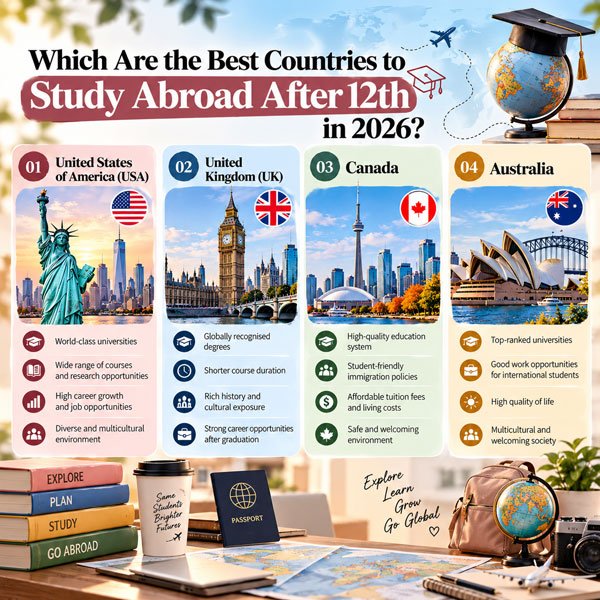
Choosing the right country is just as important as selecting the right course. Each destination offers different academic programmes, tuition fees, living expenses and career opportunities. Therefore, Indian students should compare university rankings, admission requirements, scholarship options and post-study work regulations before making a final decision.
Here are six popular study destinations to consider when planning your undergraduate education in 2026.
1. United States of America (USA)
The USA is a popular destination for undergraduate education because its universities offer a wide range of academic programmes and opportunities for specialisation. Many institutions allow students to explore different subjects before choosing a major, although the structure varies by university.
Popular courses: Computer Science, Artificial Intelligence, Engineering, Business Administration, Data Science and Biomedical Science.
Universities to explore:
- Massachusetts Institute of Technology (MIT)
- Stanford University
- Carnegie Mellon University
- Arizona State University
Duration: Most bachelor’s degree programmes take four years to complete.
Career opportunities: Depending on the degree, graduates can explore opportunities in technology, engineering, finance, research and business management.
The USA can be suitable for students seeking flexible academic options and specialised programmes. However, tuition fees and living expenses vary considerably between institutions and cities. Check the total cost of attendance and the applicable student visa rules before applying.
2. United Kingdom (UK)
The UK attracts Indian students who want to pursue internationally recognised undergraduate qualifications in a wide range of subjects. Many bachelor’s degree programmes in England, Wales and Northern Ireland take three years to complete, although some courses and professional degrees require additional time.
Popular courses: Business Management, Computer Science, Engineering, Law, Economics and Psychology.
Universities to explore:
Duration: Usually three years for many undergraduate degrees in England, Wales and Northern Ireland. Scottish bachelor’s degrees commonly take four years.
Career opportunities: Graduates can explore careers in business, finance, technology, engineering, research and other professional fields, depending on their qualifications.
One advantage of the UK is the shorter duration of many undergraduate programmes. However, international tuition fees differ by university and subject. In addition, some courses require entrance tests, interviews or specific Class 12 subjects. Review the admission criteria and current visa conditions before selecting a university.
3. Canada
Canada offers undergraduate programmes in technology, business, engineering, healthcare and the social sciences. Students can compare universities across different provinces to find courses that match their academic interests and financial plans.
Popular courses: Computer Science, Engineering, Business Administration, Data Science, Finance and Life Sciences.
Universities to explore:
Duration: Many bachelor’s degree programmes take three to four years, depending on the university and qualification.
Career opportunities: Graduates may explore opportunities in software development, engineering, business analysis, finance and scientific research.
Canada is worth considering if you want to compare different academic programmes and locations. Nevertheless, tuition fees, housing costs and other living expenses must be included in your budget. According to the Canadian government’s EduCanada resource, international undergraduate tuition averages approximately CAD 41,746 per year in 2026, while living expenses require a separate budget. Actual costs vary by institution, programme and location.
Before accepting an offer, check the institution’s eligibility, the requirements for a Canadian study permit and the latest post-graduation work permit rules. These policies can change, so use official government information when planning your studies.
4. Australia
Australia offers undergraduate programmes in engineering, information technology, business, healthcare, environmental science and design. Many universities also provide practical learning opportunities through industry projects, laboratory work and eligible placements.
Popular courses: Information Technology, Engineering, Nursing, Business, Data Science and Environmental Science.
Universities to explore:
- University of Melbourne
-
How Can You Apply to Study Abroad After 12th?
Applying to an overseas university requires careful preparation, from selecting a suitable course to obtaining a student visa. Although the exact process varies by country and institution, following a clear plan helps you organise your documents, meet deadlines and avoid common application mistakes.
Here are the main steps to follow when applying for undergraduate admission abroad in 2026.
Step 1: Select Your Course and Study Destination
Start by identifying courses that match your Class 12 subjects, academic interests and career goals. Next, compare universities in countries such as the USA, UK, Canada, Australia, Germany and Ireland. Consider course duration, tuition fees, living expenses and eligibility requirements before creating a shortlist.
Step 2: Check Admission Requirements
Each university has its own admission criteria. Some programmes require specific Class 12 subjects or minimum marks, while others ask for entrance examination scores, portfolios or interviews. Therefore, check the official course page carefully before submitting an application.
Step 3: Prepare Your Documents
Most undergraduate applications require academic records and personal identification documents. Depending on the university and course, additional documents may also be necessary.
- Class 10 and Class 12 marksheets or transcripts
- Valid passport
- English language proficiency test results, if required
- Statement of purpose or personal statement, if required
- Letters of recommendation, if required
- Portfolio or entrance examination results for selected programmes
- Financial documents when requested
Keep digital copies of your documents ready and check whether certified translations or specific document formats are required. In addition, ensure that your name, date of birth and academic details are consistent across all records.
Step 4: Submit Your University Applications
Complete each application through the university’s official portal or an approved application platform. Review the information carefully before submission, pay the required application fee and save the confirmation for future reference.
Furthermore, track application deadlines and check your email regularly for admission decisions or requests for additional documents. If you receive multiple offers, compare the course structure, tuition fees, scholarship conditions and location before accepting one.
Step 5: Apply for Scholarships and Arrange Finances
After identifying suitable universities, review available scholarships and financial assistance. Some awards require a separate application, while others are assessed automatically during admission. Check the eligibility criteria, renewal conditions and application deadlines for each award.
Prepare a realistic budget covering tuition fees, accommodation, food, insurance, transport and visa expenses. If financial proof is required for your student visa, ensure that the documents meet the destination country’s current requirements.
Step 6: Apply for Your Student Visa
Once you receive an eligible admission offer, review the student visa requirements for your destination. The process may involve submitting an online application, providing financial evidence, attending an appointment and completing biometrics or a medical examination where required.
For country-specific information, consult the official resources below:
- USA student visa information
- UK Student visa requirements
- Canada study permit application
- Australia Student visa subclass 500
- German visa information for applicants in India
- Ireland immigration information
Visa approval is not guaranteed, even when a university has accepted your application. Therefore, submit accurate documents, follow the latest official instructions and allow sufficient time for processing.
For additional assistance with the application process, explore Nexa Overseas application and admission assistance and visa guidance services.
Frequently Asked Questions About the Best Courses to Study Abroad After 12th
1. Which Is the Best Course to Study Abroad After 12th in 2026?
The best course depends on your academic background, interests, budget and career plans. Computer Science, Engineering, Business Administration, Data Science, Healthcare and Finance are popular options. Compare the curriculum, admission requirements and career pathways before selecting a programme.
2. Can Indian Students Study Abroad After 12th Without IELTS?
Yes, some universities accept alternative English proficiency tests or waive the IELTS requirement when specific conditions are met. However, acceptance policies vary by institution, and visa requirements may differ. Check the university’s official admission criteria before applying.
3. Which Country Is More Affordable for Studying Abroad After 12th?
Germany can offer comparatively affordable tuition at certain public universities, although fees vary by institution and state. Other destinations may also offer affordable programmes or scholarships. Compare tuition fees, accommodation, living expenses and travel costs to calculate the total budget.
4. Can Indian Students Get Scholarships After Class 12?
Yes, eligible Indian students can apply for undergraduate scholarships offered by universities, foundations and other funding organisations. Awards may depend on academic performance, financial circumstances or the selected programme. Check eligibility rules and deadlines before submitting an application.
5. What Are the Best Courses Abroad for Science Students?
Science students can consider Computer Science, Artificial Intelligence, Engineering, Data Science, Biotechnology, Biomedical Science and Medicine. Mathematics and Biology requirements differ by programme. Review the subject prerequisites before finalising your university shortlist.
6. Can Commerce Students Study Abroad After 12th?
Yes, Commerce students can apply for eligible undergraduate programmes in Business Administration, Accounting, Finance, Economics, Marketing and International Business. Some courses require Mathematics, while others accept applicants without it. Check the entry requirements of each university.
7. What Documents Are Required to Study Abroad After 12th?
Common documents include Class 10 and Class 12 academic records, a valid passport and English proficiency results where required. Certain universities also request recommendation letters, personal statements, portfolios or entrance examination scores. Student visa applications require additional documents depending on the destination.
8. How Early Should You Apply to Study Abroad After 12th?
Start researching universities around 12 to 18 months before your intended intake whenever possible. This allows time to prepare for examinations, collect documents, apply for scholarships and complete visa formalities. However, application timelines vary by country, institution and programme.
Conclusion: Choose the Best Courses to Study Abroad After 12th for Your Future
Choosing the best courses to study abroad after 12th requires more than comparing university rankings or selecting a popular destination. Your academic background, interests, budget and long-term career plans should guide the decision. Computer Science, Engineering, Business Administration, Data Science, Healthcare, Finance and Design offer different pathways, so research each programme before making a commitment.
In addition, compare tuition fees, living expenses, scholarship opportunities, admission criteria and professional recognition. Review official university websites and current immigration rules to make an informed decision. Careful preparation can help you avoid unnecessary expenses and select a course that matches your goals.
If you need help comparing universities, understanding admission requirements or preparing your student visa application, visit Nexa Overseas. Explore the available study abroad services or contact the counselling team to discuss suitable courses and study destinations for 2026.
Start planning your overseas education today by choosing a course that fits your interests, qualifications and future ambitions.
About Nexa Overseas
Nexa Overseas provides information and guidance for students exploring international education opportunities. Visit the About Us page to learn more about the organisation and its services. For additional educational resources, browse the Nexa Overseas blog.

Related Posts

Comments (0)