
Finding the right study abroad scholarships for Indian students can make international education much more…
Canada Student Visa Process for Indian Students: Documents, Fees And Timeline (2026)
Planning to apply for a Canada student visa from India in 2026? The process can feel confusing at first. There are admission documents to arrange, financial requirements to understand, and visa steps that must be completed in the right order.
A small mistake in the application can lead to delays. Therefore, preparing early matters. Students should understand the visa process before collecting documents or making major financial decisions.
The process usually begins with choosing a suitable institution and securing admission. Students who are still comparing programmes can explore university and course selection support before starting the admission process.
This guide explains the Canada student visa process for Indian students in simple terms. It covers required documents, application steps, fees, financial preparation, and the expected timeline for 2026.
What Is a Canada Student Visa?
The term Canada student visa is commonly used by students when discussing permission to study in Canada. However, the main document required for long term studies is a Canadian study permit.
A study permit allows an international student to study at an eligible Canadian institution under specific conditions. Depending on the application and travel requirements, other entry documents may also be issued or required.
Before applying, students should carefully check the latest immigration rules and document requirements. Visa policies can change, so relying on an old checklist from a friend or social media post can create unnecessary problems.
Students who need help understanding the latest requirements can explore professional Canada visa guidance before preparing the application.
Canada Student Visa Process for Indian Students in 2026
The Canada student visa process involves several stages. Admission comes first. After receiving the required admission documents, students can begin preparing the study permit application.
The exact process may vary depending on the student’s profile and current Canadian immigration requirements. Still, most applicants follow a similar application path.
Step 1: Choose a Suitable Canadian Institution and Course
Start by selecting a course that matches previous education and future career plans. For example, a student with an information technology background may consider programmes in computer science, cybersecurity, data analytics, or related fields.
Course selection needs careful thought. Choosing a programme only because it is popular may create questions about academic progression and study plans.
The institution also matters. Students should confirm the current eligibility and admission requirements before paying tuition fees or accepting an offer.
Professional course and university selection guidance can help students compare suitable options based on academic history, budget, and career plans.
Step 2: Apply for Admission
Once the university or college shortlist is ready, the next step is submitting admission applications. Each institution has its own entry requirements and deadlines.
Students may need academic transcripts, mark sheets, a passport copy, English language test scores, a Statement of Purpose, and other programme specific documents.
Some courses may also ask for a resume, Letters of Recommendation, portfolio, or additional academic evidence. Therefore, checking every requirement before submission can prevent avoidable delays.
Students who want support with applications and document preparation can use application and admission assistance to complete the process more carefully.
Step 3: Receive the Letter of Acceptance
After reviewing the application, the Canadian institution may issue an admission offer. Students must read the offer conditions carefully before accepting it.
The Letter of Acceptance is an important document for the study permit application. Details such as the student’s name, programme, institution, and study dates should be checked for accuracy.
Do not rush past this step. If any information appears incorrect, contact the institution before proceeding with the visa application.
Step 4: Arrange Financial Documents
Financial preparation is a major part of the Canada student visa process. Students need to show that sufficient funds are available for education and living expenses.
Depending on the case, financial documents may include bank statements, education loan documents, tuition payment receipts, sponsor income evidence, or other proof of available funds.
The source of funds should also be clear. Large unexplained deposits or incomplete financial documents may create unnecessary questions during application assessment.
Therefore, students should arrange financial records early instead of collecting everything a few days before submitting the application.
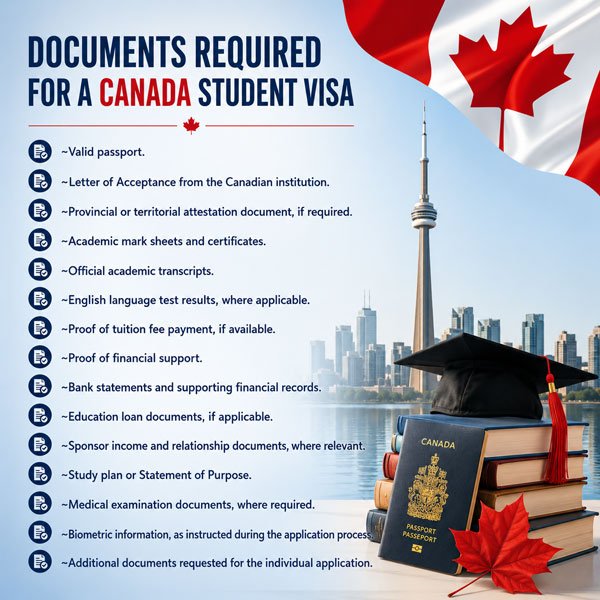
Documents Required for a Canada Student Visa
Document preparation often takes more time than expected. A missing file, unclear scan, or incorrect detail can slow down the application process.
The exact document list can depend on the applicant’s profile. However, Indian students commonly prepare the following documents for a Canada study permit application.
- Valid passport.
- Letter of Acceptance from the Canadian institution.
- Provincial or territorial attestation document, if required.
- Academic mark sheets and certificates.
- Official academic transcripts.
- English language test results, where applicable.
- Proof of tuition fee payment, if available.
- Proof of financial support.
- Bank statements and supporting financial records.
- Education loan documents, if applicable.
- Sponsor income and relationship documents, where relevant.
- Study plan or Statement of Purpose.
- Medical examination documents, where required.
- Biometric information, as instructed during the application process.
- Additional documents requested for the individual application.
Every document should be readable and consistent with the information entered in the application. Names, dates, education history, and financial details need careful checking.
For students preparing for IELTS, TOEFL, GRE, or GMAT as part of the wider admission process, exam preparation support can help with structured test preparation.
How Much Does a Canada Student Visa Cost in 2026?
Understanding the cost of a Canada student visa helps students prepare a realistic budget before applying. The visa application fee is only one expense. Biometrics, medical examinations, document preparation, and travel costs may also affect the final amount.
Students should always confirm the latest government fees before making a payment. Immigration charges can change, and outdated figures may lead to incorrect budgeting.
| Expense | Estimated Cost |
|---|---|
| Study Permit Application Fee | CAD 150 |
| Biometrics Fee | CAD 85 for an individual applicant |
| Medical Examination | Varies by approved medical provider |
| Language Test Fee | Depends on the selected test |
| Document and Courier Expenses | Varies depending on the application |
These costs do not include university tuition fees, accommodation, flight tickets, or daily living expenses in Canada. Therefore, students should prepare a complete education budget instead of focusing only on the visa fee.
Scholarships may help reduce tuition expenses for eligible applicants. Students searching for suitable funding options can explore scholarship support before finalising university applications.
Proof of Funds for a Canada Student Visa
Financial proof is an important part of the Canada student visa process. The visa officer needs to understand how the student plans to pay tuition fees and manage living expenses during the study period.
Simply showing money in a bank account may not always explain the complete financial situation. The source of funds, sponsor details, income records, and supporting documents should make sense together.
Common financial documents may include:
- Recent bank statements.
- Education loan sanction letter.
- Tuition fee payment receipt.
- Guaranteed Investment Certificate, where applicable.
- Scholarship confirmation letter.
- Fixed deposit records, where relevant.
- Sponsor income documents.
- Income Tax Returns of the sponsor.
- Employment or business income evidence.
Financial requirements can change. In addition, the amount required may depend on the applicant’s circumstances and accompanying family members.
For this reason, students should check current immigration requirements before submitting financial documents. Guessing the required amount or using an old checklist is risky.
Is IELTS Required for a Canada Student Visa?
This is one of the most common questions Indian students ask. IELTS is widely accepted by Canadian institutions, but admission and immigration requirements should not be treated as the same thing.
A university or college may ask for proof of English language proficiency. Depending on the institution and programme, accepted tests may include IELTS Academic, TOEFL, PTE Academic, or another recognised test.
Students should first check the exact language requirement of the selected institution. After that, the study permit application should be prepared according to the latest immigration requirements.
A low language score may also affect university options. Therefore, early preparation gives students enough time to improve their performance or retake the test if necessary.
Students preparing for an English proficiency test can explore IELTS and exam preparation for structured guidance.
Canada Student Visa Timeline for Indian Students in 2026
There is no single fixed timeline for every Canada student visa application. Processing time can vary based on application volume, document checks, biometrics, medical requirements, and the complexity of an individual case.
Therefore, waiting until the final few weeks before the course begins can create unnecessary pressure. Starting early gives enough time to handle additional document requests or unexpected delays.
A practical planning timeline may look like this:
| Stage | Suggested Planning Period |
|---|---|
| Research Courses and Institutions | 10 to 12 months before intake |
| Prepare for English Language Tests | 8 to 12 months before intake |
| Submit Admission Applications | 6 to 10 months before intake |
| Receive and Review Admission Offer | Depends on the institution |
| Arrange Financial Documents | Start as early as possible |
| Prepare Study Permit Application | After receiving the required admission documents |
| Complete Biometrics and Medical Requirements | As instructed during the application process |
| Plan Travel and Accommodation | After receiving the appropriate visa decision and travel documents |
This timeline is a planning guide, not a guaranteed processing schedule. Actual processing times may change throughout the year.
Students should avoid booking non-refundable travel only because a friend received a visa quickly. Every application is assessed individually.
How Long Does Canada Student Visa Processing Take?
Processing times can change during the year. Application volumes often increase before popular intakes, which may affect how long a decision takes.
The time shown on official immigration channels is generally an estimate rather than a guaranteed decision date. In addition, an incomplete application may take longer if further information is required.
Students can reduce avoidable problems by submitting readable documents, entering accurate information, and responding to official requests on time.
Professional student visa guidance can help applicants organise documents and review important application details before submission.
What Happens After Submitting the Canada Student Visa Application?
Submitting the application does not mean the process is finished. Students should regularly check official application updates and respond if additional information is requested.
Depending on the application, the next steps may include biometrics, a medical examination, document requests, or further assessment.
Complete Biometrics
Applicants may receive instructions to provide fingerprints and a photograph. The appointment should be completed within the period mentioned in the official instructions.
Keep the biometric confirmation and related records safely after the appointment.
Complete the Medical Examination
A medical examination may be required depending on immigration rules and the applicant’s circumstances. When required, students should follow the official instructions and use an authorised medical professional.
Do not submit false medical documents or altered reports. Accurate information is essential throughout the visa process.
Respond to Additional Document Requests
Immigration authorities may ask for more information or supporting documents. If this happens, read the request carefully and check the submission deadline.
A rushed response can create more confusion. Therefore, prepare the requested documents carefully and submit them through the appropriate official channel.
Common Reasons for Canada Student Visa Delays or Refusals
A Canada student visa application can face problems when important details are missing or unclear. In many cases, the issue is not one single document. Instead, the complete application may fail to explain the student’s study plans or financial situation properly.
Understanding common mistakes can help students prepare a stronger application.
- Choosing a course that does not match previous education or career plans.
- Submitting incomplete or unclear financial documents.
- Failing to explain the source of funds properly.
- Providing inconsistent information across application forms and documents.
- Writing a generic or copied study plan.
- Submitting unreadable scans or incomplete documents.
- Ignoring requests for additional information.
- Applying too close to the course start date.
For example, a student with a bachelor’s degree in information technology may need to clearly explain the reason for choosing a new academic field. A simple statement such as “Canada has good education” does not explain the academic decision.
The study plan should connect previous education, the selected programme, and future career goals. Most importantly, the explanation should be genuine and supported by the rest of the application.
Students concerned about documentation or previous application issues can explore visa guidance before preparing a new application.
How to Write a Strong Study Plan for a Canada Student Visa
A study plan gives the visa officer context about the student’s academic decision. It should explain why the selected course makes sense and how it connects with future career plans.
Avoid copying a sample from the internet. Visa officers review a large number of applications, and generic statements are easy to notice.
A useful study plan should clearly address:
- Previous academic background.
- Reason for selecting the particular course.
- Reason for choosing the Canadian institution.
- How the programme supports future career plans.
- Financial preparation for studying in Canada.
- Relevant personal or professional circumstances.
Keep the explanation direct. Real academic and career details are more useful than dramatic language.
For instance, an applicant with experience in web development may explain how a postgraduate programme in cybersecurity supports a planned move into application security. That connection is more specific than saying the course offers “global exposure and endless opportunities.”
Canada Student Visa Application Mistakes Indian Students Should Avoid
Small mistakes can create serious confusion during the Canada student visa process. Therefore, students should review the complete application before submitting it.
Some common mistakes include:
- Entering incorrect passport details.
- Using different spellings of the name across documents.
- Leaving unexplained education or employment gaps.
- Uploading the wrong document in an application section.
- Submitting expired financial records.
- Using copied content in the study plan.
- Ignoring course relevance.
- Providing unclear sponsor information.
- Waiting until the last moment to apply.
Before submission, check names, dates, academic history, employment details, and financial information again. In addition, keep a copy of the final application and supporting documents for future reference.
Can Students Apply for a Canada Student Visa Without a Consultant?
Yes. Students can prepare and submit a study permit application independently. Official immigration instructions and application systems are available online.
However, some applications require more careful planning. Previous visa refusals, education gaps, unusual financial arrangements, or a major change in academic field may need a clearer explanation.
A consultant cannot guarantee visa approval. No genuine counsellor should promise a guaranteed result. However, professional guidance can help students organise documents, identify inconsistencies, and understand the application process.
Nexa Overseas provides support through study abroad services, including course selection, admission assistance, exam preparation, scholarship support, and visa guidance.
When Should Indian Students Start the Canada Student Visa Process?
Starting early is one of the simplest ways to reduce application pressure. Ideally, students should begin researching courses and institutions several months before the preferred intake.
Early planning gives enough time to prepare for language tests, compare programmes, collect academic records, and arrange finances. It also allows students to correct document issues before important deadlines arrive.
For example, students planning a September intake should not wait until the middle of the year to start researching universities. Admission deadlines vary, and popular programmes may have limited availability.
Students can also read practical admission and visa guides on the Nexa Overseas Blog while preparing for upcoming intakes.
How Nexa Overseas Supports Canada Student Visa Applicants
A study permit application involves more than filling out an online form. Course selection, admission documents, financial records, and the study plan all need careful attention.
Nexa Overseas supports students from the initial planning stage to the visa process. The focus remains on the student’s academic profile, selected course, and application requirements.
Support may include:
- University and course selection.
- Admission application support.
- IELTS, TOEFL, GRE, and GMAT preparation.
- Scholarship guidance.
- Visa document preparation.
- Study plan guidance.
- Visa interview preparation, where required.
- Travel and accommodation support after the visa process.
Students can learn more about the consultancy and its approach through the About Nexa Overseas page.
Final Canada Student Visa Checklist Before Submission
Before submitting a Canada student visa application, students should review every form and supporting document carefully. A final check can catch simple errors that may otherwise create delays.
Use this checklist before completing the application:
- Check passport validity and personal details.
- Review the Letter of Acceptance carefully.
- Confirm that all required admission documents are available.
- Check the latest provincial or territorial attestation requirements.
- Prepare clear and readable academic documents.
- Review financial evidence and the source of funds.
- Check sponsor details and supporting income records.
- Write a genuine and course specific study plan.
- Explain education or employment gaps, where relevant.
- Check every date entered in the application forms.
- Upload documents in the correct sections.
- Review the latest visa fee and biometrics requirements.
- Keep copies of submitted forms and documents.
Do not submit the application simply because an intake deadline is getting closer. An incomplete application submitted in a hurry can create more problems than taking extra time to review important details.
Students who need support at different stages of the process can explore the complete Nexa Overseas services before moving ahead with the application.
Why Early Planning Matters for a Canada Student Visa
Visa preparation should not begin after every admission deadline has passed. Early planning gives students more time to compare institutions, prepare for English language tests, arrange financial documents, and review course options.
It also helps families understand the expected education budget. For example, education loans and sponsor documents may take time to arrange. Waiting until the final month can make the financial process unnecessarily stressful.
In addition, early applicants have more time to deal with unexpected document requests. A missing transcript or incorrect name on an academic document is easier to fix when the course start date is still several months away.
Students who are at the early research stage can visit the Nexa Overseas website to explore study abroad support and available services.
Prepare for the Canada Student Visa Process with the Right Information
Applying for a Canada student visa requires patience and careful document preparation. There is no useful shortcut for a poorly planned application.
Start with a relevant course. Check the institution carefully. Arrange financial evidence early and make sure the study plan reflects the student’s actual academic and career goals.
Most importantly, use current information. Visa rules and document requirements may change, so an old application checklist should never replace the latest official requirements.
For personalised support with university applications and visa preparation, book a free consultation with Nexa Overseas. A counsellor can review the study plan and explain the next steps based on the student’s profile.
Conclusion
The Canada student visa process becomes easier to manage when every stage is planned properly. Students need to secure admission, prepare financial evidence, collect supporting documents, complete the study permit application, and respond to official instructions on time.
Starting early can prevent rushed decisions. Moreover, a course that matches the student’s academic background and career plans creates a clearer study path.
Visa rules, fees, and financial requirements may change. Therefore, students should always check the latest official requirements before submitting an application.
Need help understanding the next step? Contact Nexa Overseas for a free consultation and discuss the Canada study plan with an experienced counsellor.
Frequently Asked Questions About Canada Student Visa
1. What is the Canada student visa fee for Indian students?
The study permit application fee is generally CAD 150. Biometrics and other application related expenses may apply separately. Students should confirm the latest official fees before making a payment.
2. How long does a Canada student visa take in 2026?
Processing times can change based on application volume and individual circumstances. Students should check the latest official processing time and apply well before the course start date.
3. Is IELTS compulsory for a Canada student visa?
Language requirements can depend on the institution, programme, and current immigration rules. IELTS is widely accepted, although other recognised English language tests may also be accepted in certain cases.
4. How much bank balance is required for a Canada student visa?
The required financial amount depends on current immigration requirements, tuition fees, and the applicant’s circumstances. Students should check the latest proof of financial support requirements before applying.
5. Can a Canada student visa be rejected?
Yes. An application may be refused if the visa officer has concerns about the study plan, financial evidence, documentation, or other application details.
6. Can a student reapply after a Canada student visa refusal?
A student may submit a new application after a refusal. However, the reasons mentioned in the refusal should be reviewed carefully before reapplying.
7. Is a Letter of Acceptance required for a Canada study permit?
A valid Letter of Acceptance from an eligible Canadian institution is generally an important part of the study permit application.
8. When should Indian students apply for a Canada student visa?
Students should begin the admission process several months before the preferred intake. The study permit application can be prepared after receiving the required admission documents.
9. Can parents sponsor education in Canada?
Parents may support a student’s education expenses. However, the application should include suitable financial and sponsor documents that clearly explain the source of funds.
10. How can Nexa Overseas help with the Canada student visa process?
Nexa Overseas provides support for course selection, admission applications, exam preparation, scholarships, visa documentation, study plan guidance, and post visa travel planning.

Related Posts

Comments (0)