
Planning to study in Germany can be a smart option for Indian students who want…
Top Scholarships for Indian Students to Study Abroad in 2026: Fully Funded Options, Eligibility and Deadlines
Finding the right study abroad scholarships for Indian students can make international education much more affordable. Tuition fees, accommodation, travel, insurance, and daily expenses can add up quickly, so a scholarship can reduce a major part of the financial pressure.
However, getting a scholarship is not simply about filling out an application. Each scholarship has its own eligibility rules, academic requirements, documents, deadlines, and selection process. Therefore, students should start researching early and choose scholarships that match their course, destination, academic background, and career plans.
This guide covers some of the major scholarships available to Indian students planning to study abroad in 2026. It also explains what these scholarships generally cover, who can apply, and how to improve the chances of receiving financial support.
Why Study Abroad Scholarships Matter for Indian Students
Studying in another country can offer valuable academic and career opportunities, but the overall cost can be a concern for many families. A scholarship can help reduce tuition expenses or provide financial support for other study-related costs.
In addition, scholarships can make it easier to consider universities that may otherwise seem financially difficult. Some awards cover a portion of tuition, while others can provide broader financial support depending on the scholarship and university.
Before applying, students should understand exactly what an award covers. A scholarship advertised as fully funded may have different coverage from one university or programme to another.
- Tuition fee support
- Living and accommodation expenses
- Travel or airfare support in selected programmes
- Health insurance in certain scholarships
- Study materials or other academic costs
For personalised guidance on finding suitable funding options, students can explore scholarship support while planning their applications.
What Are Study Abroad Scholarships?
Study abroad scholarships are financial awards offered to students who want to pursue education outside their home country. Governments, universities, foundations, international organisations, and private institutions can offer these scholarships.
The selection criteria can vary considerably. Some awards focus mainly on academic performance, while others consider leadership, professional experience, financial need, community involvement, research interests, or a combination of several factors.
There are also different types of scholarships. For example, a university may offer a merit-based tuition reduction, while a government-funded programme may provide support for tuition, living expenses, travel, and other costs.
Common Types of Scholarships
- Merit-based scholarships: Offered mainly on the basis of academic performance, achievements, or other demonstrated strengths.
- Need-based scholarships: Designed to provide financial assistance based on a student’s financial circumstances.
- Government scholarships: Funded by national governments to attract international students or support educational exchange.
- University scholarships: Offered directly by universities for eligible international students.
- Fully funded scholarships: These can cover several major study-related expenses, although the exact benefits depend on the programme.
Because the conditions differ, students should always read the official scholarship requirements before preparing an application.
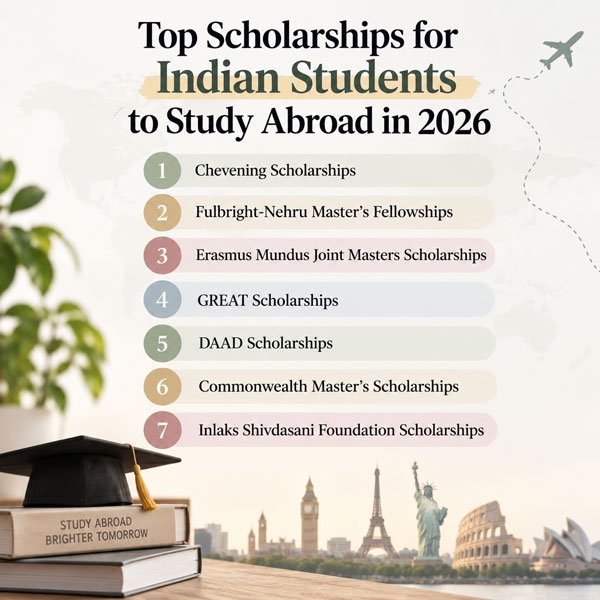
Top Scholarships for Indian Students to Study Abroad in 2026
Several well-known scholarship programmes are worth researching for international study. The right option depends on the country, degree level, field of study, academic profile, and eligibility requirements.
1. Chevening Scholarships
The Chevening Scholarship is a well-known UK government scholarship for eligible students who want to pursue a master’s degree in the United Kingdom. It is aimed at individuals who can demonstrate leadership potential and strong professional or academic backgrounds.
Chevening scholarships can provide substantial financial support for an eligible one-year master’s programme. The exact eligibility requirements and application dates should be checked on the official Chevening website because they can change between application cycles.
Applicants should also pay close attention to the required work experience, university course selection, references, and application essays. A strong academic record helps, but the overall profile and ability to demonstrate leadership and future impact are also important.
2. Fulbright-Nehru Master’s Fellowships
For Indian students considering higher education in the United States, the Fulbright-Nehru programme is an important scholarship option to research. The programme supports selected Indian students for master’s-level study in specific fields at eligible US institutions.
The selection process can consider academic achievements, professional experience, leadership qualities, community involvement, and the applicant’s proposed area of study. Eligibility also depends on the specific fellowship cycle and field.
Students interested in this opportunity should prepare their academic documents, professional details, recommendations, and personal statements well in advance. Since application requirements can be detailed, early preparation is useful.
3. Erasmus Mundus Joint Masters Scholarships
Erasmus Mundus Joint Masters programmes are another strong option for students looking at Europe. These programmes are delivered by international partnerships between universities, allowing students to study in more than one country during the degree in many cases.
Selected students can receive scholarships that provide significant financial support. However, benefits and eligibility can vary by programme, so there is no single set of requirements for every Erasmus Mundus course.
One important point is that students should first identify suitable Erasmus Mundus programmes based on their academic background and career goals. After that, the specific programme page should be checked for eligibility, documents, application deadlines, and scholarship conditions.
4. GREAT Scholarships
GREAT Scholarships are offered through participating UK universities and are supported by the British Council and partner institutions. Indian students can find opportunities under the programme, although the participating universities, courses, award values, and eligibility conditions can vary from one year to another.
These scholarships are generally aimed at postgraduate students and can provide financial support towards tuition fees. However, students should check the individual university’s requirements because the scholarship conditions are not identical across all participating institutions.
A strong application should clearly explain academic goals, career plans, and why the selected course is relevant. Students should also check whether the university requires a separate scholarship application in addition to the admission application.
5. DAAD Scholarships
DAAD is one of the major sources of scholarships for international students interested in studying in Germany. It offers a wide range of funding opportunities, particularly for graduates, doctoral students, researchers, and other academic groups.
The eligibility criteria, funding, duration, and application process depend on the specific DAAD programme. Some opportunities may support tuition-related costs, living expenses, travel, insurance, or other study-related expenses.
Students planning to study in Germany should therefore search for programmes that match their academic qualification and intended course. It is also important to check the language requirements and application conditions before applying.
6. Commonwealth Master’s Scholarships
Commonwealth Master’s Scholarships are designed for eligible students from Commonwealth countries who want to pursue master’s-level study in the United Kingdom. Indian students may be eligible for relevant opportunities depending on the scholarship cycle and programme requirements.
The scholarship focuses on students who have strong academic potential and who can demonstrate how their education can contribute to development. The application normally requires careful preparation of academic information, supporting documents, and personal statements.
Since eligibility and participating programmes can change, students should always refer to the official scholarship information for the relevant intake.
7. Inlaks Shivdasani Foundation Scholarships
The Inlaks Shivdasani Foundation provides scholarships for talented Indian students pursuing higher education at selected institutions abroad. The scholarship can be relevant to students applying for advanced study in areas covered by the foundation’s current programme.
Applicants generally need a strong academic and overall profile. The selection process can also consider achievements, the quality of the proposed study plan, and the applicant’s potential in the chosen field.
Because the foundation has specific eligibility rules and application conditions, students should review the latest information before preparing their application.
How to Choose the Right Scholarship
There is no single best scholarship for every student. A scholarship that suits a master’s applicant may not be suitable for someone applying for an undergraduate or doctoral programme.
Start by comparing the scholarship with the intended course and destination. Then check the eligibility criteria carefully before spending time on the application.
- Check whether the scholarship is open to Indian citizens.
- Confirm the eligible degree level and field of study.
- Review academic and professional requirements.
- Check whether financial need is considered.
- Understand exactly which expenses are covered.
- Note the application deadline and required documents.
- Check whether a separate university application is required.
Course selection should come before chasing a scholarship simply because it offers a large financial award. Students can use university and course selection assistance to compare suitable study options before building a scholarship strategy.
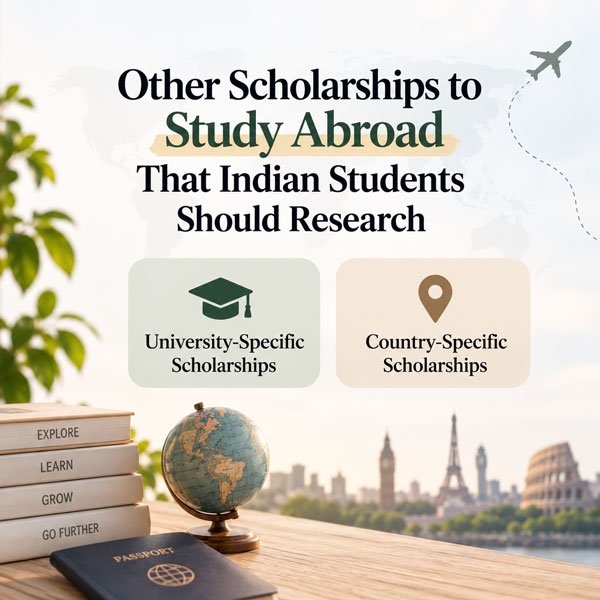
Other Scholarships to Study Abroad That Indian Students Should Research
The scholarships above are not the only funding options available. Many universities and educational institutions offer their own scholarships to international students. These awards can sometimes be easier to target because they are linked directly to a particular university or course.
Students should also research country-specific scholarships, university merit awards, subject-specific funding, research grants, and scholarships offered by private foundations. Searching across several categories can increase the number of suitable opportunities.
University-Specific Scholarships
Many universities provide scholarships based on academic performance, leadership, extracurricular achievements, research interests, or financial circumstances. Some awards are automatically considered when a student submits an admission application, while others require a separate form.
For this reason, checking the university’s official scholarship page should become part of the admission research process. Students should not assume that every scholarship is automatically considered with the university application.
Country-Specific Scholarships
Several countries provide scholarships or funding programmes for international students. The availability depends on the country, degree level, subject, institution, and academic year.
For example, students researching the UK, USA, Germany, Canada, Australia, or European study destinations can create a separate scholarship list for each country. This makes it easier to compare eligibility requirements and deadlines.
What Do Fully Funded Scholarships Usually Cover?
The phrase fully funded scholarships is often used when a scholarship provides substantial financial support. However, the exact meaning of fully funded can differ between programmes.
A scholarship may cover tuition fees and living expenses but have separate conditions for travel or accommodation. Another programme may include several additional benefits. Therefore, students should never judge a scholarship only by its title.
Depending on the programme, financial support may include:
- Full or partial tuition fees
- Monthly living allowance
- Accommodation support
- Travel allowance or airfare support
- Health or medical insurance
- Study or research-related expenses
- Visa-related support in selected programmes
The official scholarship provider should always be treated as the final source for current funding details. Scholarship conditions can change between academic years, so older information found online may not apply to the 2026 intake.
Scholarships for Undergraduate Students
Students planning undergraduate education abroad can also find scholarship opportunities, although the options differ from those available at master’s and doctoral levels.
Universities may offer merit-based tuition awards to international students based on academic performance. Some institutions also consider extracurricular achievements, entrance test results, leadership activities, or other factors.
Undergraduate applicants should start researching scholarships at the same time as university applications. In some cases, the scholarship deadline can be earlier than the admission deadline.
Students should also check whether the scholarship is renewable for each year of study or available only for the first year. This distinction can make a significant difference when calculating the total cost of an overseas degree.
Scholarships for Master’s and PhD Students
Master’s and PhD students can access a wider range of international funding opportunities, particularly through governments, universities, research institutions, and international organisations.
Research-focused scholarships may place greater importance on academic performance, research interests, publications, professional experience, or a detailed study proposal. Therefore, applicants should prepare more than just their academic transcripts.
A well-written statement of purpose can help explain academic goals and career direction. Research applicants may also need a research proposal, academic references, or evidence of previous research work, depending on the programme.
Students can also review exam preparation support when an overseas university or scholarship requires standardised tests such as IELTS, TOEFL, GRE, or GMAT.
How to Find International Scholarships for Indian Students
Finding suitable international scholarships for Indian students requires more than searching for the phrase “fully funded scholarship” online. A better approach is to create a shortlist based on the intended destination, degree, subject, university, and eligibility profile.
Start with official scholarship databases, university websites, government education portals, and recognised scholarship providers. Then compare the opportunities based on eligibility, funding, application requirements, and deadlines.
- Choose the preferred study destination.
- Shortlist suitable universities and courses.
- Search for government and university scholarships.
- Check the eligibility requirements carefully.
- Compare the financial benefits offered.
- Create a list of required documents.
- Record every scholarship deadline in one place.
- Prepare applications according to each scholarship’s specific requirements.
Students who need help with the admission side can also review application and admission assistance before submitting university applications.
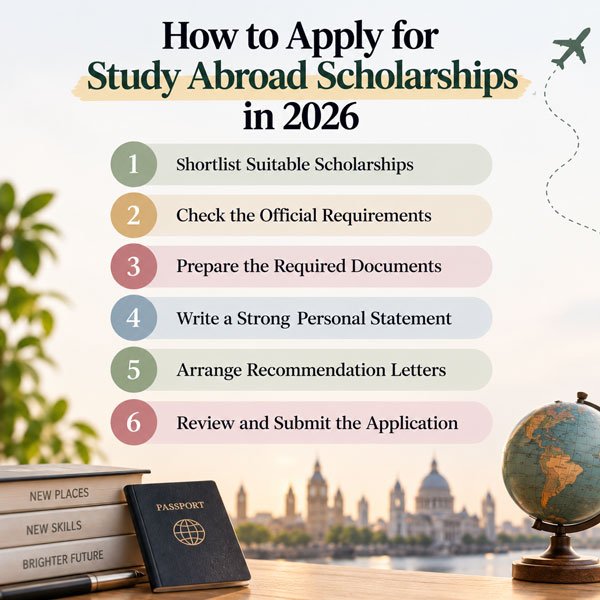
How to Apply for Study Abroad Scholarships in 2026
Applying for study abroad scholarships 2026 requires planning. Scholarship committees often receive a large number of applications, so submitting the same generic application everywhere is rarely a good strategy.
Instead, each application should be prepared according to the scholarship’s eligibility criteria and selection process. Start several months before the deadline so there is enough time to collect documents, write essays, request recommendation letters, and review the final application.
Step 1: Shortlist Suitable Scholarships
Begin by making a list of scholarships that match the intended degree, subject, destination, academic background, and career plans. Do not apply simply because a scholarship offers a large financial award.
Read the eligibility requirements carefully. If a student does not meet a basic requirement, applying may waste valuable time that could be used for a more suitable opportunity.
Step 2: Check the Official Requirements
Every scholarship has its own rules. Some may require professional experience, while others may focus more heavily on academic performance or research potential.
Check the official scholarship page for information about eligibility, eligible courses, required documents, funding, application dates, and selection criteria. Always use the latest information for the relevant application cycle.
Step 3: Prepare the Required Documents
Most scholarship applications require several supporting documents. Preparing them early can prevent last-minute problems, especially when documents need to be translated, certified, or requested from an institution.
- Academic transcripts and certificates
- Valid passport
- Updated CV or resume
- Statement of purpose or personal statement
- Letters of recommendation
- Proof of work experience, where required
- English language test results, if required
- Research proposal for selected postgraduate programmes
- University admission documents, where applicable
The exact document list depends on the scholarship. Therefore, applicants should create a separate checklist for every application.
Step 4: Write a Strong Personal Statement
A personal statement gives the scholarship committee a clearer idea of the applicant’s academic background, goals, experience, and reasons for choosing the programme.
Avoid simply repeating information already included in the CV. Instead, explain why the selected course matters, what skills or experience have shaped the academic direction, and how the qualification connects with future career plans.
Specific examples are usually more effective than broad claims. For instance, instead of saying that leadership is a strength, describe a project, responsibility, achievement, or situation that demonstrates leadership.
Step 5: Arrange Recommendation Letters
Some scholarships require academic or professional references. Choose referees who know the applicant’s work well and can provide specific examples of academic ability, professional performance, leadership, or potential.
Do not wait until the final week to request recommendations. Give referees enough time to prepare a thoughtful letter and provide them with the scholarship details and application deadline.
Step 6: Review and Submit the Application
Before submitting, review every section carefully. Check spelling, dates, academic information, document formats, essay word limits, and contact details.
Make sure every required document has been uploaded correctly. Finally, save a copy of the submitted application and confirmation email for future reference.
How to Improve Your Chances of Getting Scholarships to Study Abroad
There is no guaranteed formula for receiving a scholarship. However, a well-prepared application can present the applicant’s strengths more clearly and reduce avoidable mistakes.
Build a Strong Academic Profile
Academic performance is an important factor for many scholarships. Keep transcripts, certificates, project work, research achievements, and other academic records organised from the beginning.
However, academic marks are not always the only consideration. Some scholarships also look at leadership, professional experience, community involvement, research potential, or a clear career plan.
Show Relevant Achievements
Scholarship applications should focus on achievements that are relevant to the programme and scholarship. Academic competitions, internships, research projects, professional experience, volunteering, leadership roles, and significant projects can strengthen an application when presented with clear evidence.
Quality matters more than filling an application with a long list of unrelated activities. Explain what was achieved and what was learned from the experience.
Connect the Scholarship With Career Goals
A scholarship application becomes stronger when the academic plan and career direction make sense together. Explain why the selected course is important and how the knowledge gained can support future professional goals.
For example, an applicant pursuing environmental science could explain how the selected programme connects with previous academic work and a planned career in environmental research or sustainability. The explanation should be specific rather than relying on general statements.
Apply to Multiple Suitable Scholarships
Relying on a single scholarship can limit the available options. Instead, create a shortlist of realistic opportunities and apply to several scholarships where the eligibility criteria genuinely match.
This does not mean submitting identical applications everywhere. Each personal statement and scholarship essay should be adjusted to address the specific objectives and requirements of the programme.
Common Mistakes Students Make When Applying for Scholarships
Even strong students can lose opportunities because of simple application mistakes. Careful preparation can prevent many of these problems.
- Applying without checking eligibility: Always confirm the basic requirements before starting an application.
- Missing the deadline: Keep every scholarship deadline in a separate calendar or tracking sheet.
- Using the same essay everywhere: Adapt the statement to the scholarship and its objectives.
- Ignoring document requirements: Check file formats, translations, certifications, and word limits carefully.
- Writing vague career goals: Give a clear explanation of academic and professional plans.
- Waiting until the last minute: Recommendation letters and official documents can take time to arrange.
- Assuming every scholarship is fully funded: Read the funding conditions carefully to understand what is actually covered.
Scholarship and University Applications Should Be Planned Together
Scholarship planning should not be treated as a completely separate process from university admission. In many cases, the scholarship depends on admission to an eligible course or institution.
Students should therefore create a timeline covering university applications, scholarship applications, entrance requirements, English language tests, financial documents, and visa preparation.
Admission requirements can differ significantly between universities. Reviewing study abroad services can help students understand the different stages involved in the overall application process.
Students should also review visa guidance after receiving an offer and confirming the funding arrangements. A scholarship does not automatically mean that every visa or financial requirement has been satisfied.
A Simple Scholarship Planning Timeline
Starting early gives applicants more time to build a strong application. A simple timeline can make the process easier to manage.
- 9 to 12 months before intake: Research universities, courses, scholarships, and eligibility requirements.
- 6 to 9 months before intake: Prepare for required entrance or English language tests and organise academic documents.
- 4 to 6 months before intake: Prepare personal statements, CVs, recommendation letters, and scholarship applications.
- 2 to 4 months before intake: Submit applications according to individual deadlines and track responses.
- After receiving an offer: Review funding conditions, confirm the university place, and begin the next stages of the admission and visa process.
These timeframes are general planning guidelines rather than fixed scholarship deadlines. Every scholarship and university can follow a different calendar, so official dates should always be checked before applying.
Why Early Scholarship Research Matters
Many students begin looking for funding only after receiving a university offer. By then, some scholarship deadlines may already have passed.
Starting early allows time to compare different scholarships, improve academic or test profiles, prepare documents, and write stronger applications. It also gives students a better opportunity to identify alternatives if the first scholarship does not work out.
For students who are still deciding between countries or universities, Nexa Overseas provides information and guidance for different stages of the study abroad process.
Frequently Asked Questions About Study Abroad Scholarships
1. Which are the best scholarships for Indian students to study abroad?
Some well-known options include Chevening, Fulbright-Nehru, Erasmus Mundus Joint Masters, GREAT Scholarships, DAAD scholarships, and Commonwealth Master’s Scholarships. The best option depends on the student’s degree level, destination, subject, academic profile, and eligibility.
2. Can Indian students get fully funded scholarships to study abroad?
Yes, eligible Indian students can apply for scholarships that provide substantial or full financial support. However, funding differs between programmes. Students should check the official scholarship conditions to understand exactly which costs are covered.
3. What expenses can study abroad scholarships cover?
Depending on the scholarship, financial support can include tuition fees, living expenses, accommodation, travel, health insurance, or other study-related costs. Some scholarships cover only one part of the total cost, so the funding details should be checked carefully.
4. How can Indian students find study abroad scholarships in 2026?
Students can search official government scholarship portals, university websites, international scholarship databases, and recognised organisations. The search should be based on the intended country, course, degree level, academic profile, and eligibility criteria.
5. Do scholarships require IELTS or other English language tests?
Some scholarships or the universities linked to them may require proof of English language proficiency. IELTS, TOEFL, or another accepted test may be required depending on the institution and programme. Always check the specific admission and scholarship requirements.
6. Can students apply for more than one scholarship?
Yes, students can generally apply for multiple scholarships when they meet the eligibility requirements. However, each scholarship should be treated as a separate application, with its own documents, essays, conditions, and deadlines.
7. When should Indian students start applying for scholarships?
Starting several months before the intended intake is recommended. Some scholarships have deadlines well before university admission deadlines, so early research gives students enough time to prepare documents, tests, recommendation letters, and personal statements.
8. Are scholarships available for undergraduate students?
Yes. Many universities offer scholarships for international undergraduate students, particularly merit-based tuition awards. Availability and eligibility vary by university, course, country, and academic year.
9. Are scholarships available for master’s and PhD programmes?
Yes. Master’s and PhD students can find funding through universities, governments, research organisations, and international scholarship programmes. Research-focused applicants may need additional documents such as a research proposal or academic references.
10. Does getting a scholarship guarantee a student visa?
No. A scholarship and a student visa are separate processes. Students must still meet the visa requirements of the destination country, including any applicable financial, academic, documentation, and admission conditions.
Final Thoughts on Study Abroad Scholarships for Indian Students
Finding the right study abroad scholarships for Indian students takes time, but proper planning can make the process much more manageable. There are opportunities offered by governments, universities, foundations, and international organisations, so students should look beyond a single scholarship programme.
The strongest approach is to start with the preferred course and destination, then identify scholarships that genuinely match the student’s profile. Check eligibility carefully, prepare documents early, write specific personal statements, and keep track of every deadline.
Scholarship information can change from one academic year to another. Therefore, students should confirm the latest eligibility criteria, funding details, participating universities, and deadlines directly with the official scholarship provider before submitting an application.
Students who need guidance with university selection, applications, scholarships, or the next stages of studying abroad can contact Nexa Overseas for a consultation.

Related Posts


Comments (0)