
Finding the right study abroad scholarships for Indian students can make international education much more…
Study Abroad Without IELTS: Countries, Universities And Admission Guide (2026)
Many students believe that an IELTS score is the only way to secure admission to an international university. However, that is no longer true. Several countries and universities now offer opportunities to study abroad without IELTS by accepting alternative English language requirements or evaluating previous academic qualifications. As a result, students have more options than ever before when planning higher education overseas.
Choosing the right destination still requires careful research. Every university has different admission policies, document requirements, and eligibility criteria. Therefore, understanding these requirements before applying can save both time and effort.
Students who are unsure where to begin can explore the services offered by Nexa Overseas. Professional guidance makes it easier to compare countries, shortlist universities, and prepare a strong application based on academic goals.
This complete guide explains everything about study abroad without IELTS, including eligible countries, universities, admission requirements, alternative English language tests, student visa considerations, and useful tips for securing admission in 2026.
Can Students Study Abroad Without IELTS?
Yes. Many universities around the world now accept students without an IELTS score. Instead of relying on a single English language test, institutions may accept other recognised qualifications or assess English proficiency through different methods.
For example, some universities accept students who completed previous education in English medium schools or colleges. Others may conduct an online interview or request alternative language test scores such as TOEFL, PTE Academic, Duolingo English Test, or Cambridge English qualifications.
Nevertheless, admission policies differ between universities. Therefore, checking the latest requirements before submitting an application is always recommended.
Students planning to compare universities can also receive personalised support through university and course selection before making a final decision.
Why Choose to Study Abroad Without IELTS?
Many students prepare for IELTS successfully. However, others prefer universities that offer flexible admission options because of limited preparation time, examination costs, or previous English medium education.
Studying abroad without IELTS also allows students to apply to universities that recognise other forms of English proficiency. Consequently, students can focus on selecting the right course instead of delaying admission because of one examination.
Some of the biggest advantages include:
- More university options with flexible admission policies.
- Reduced application timelines for eligible students.
- Acceptance of alternative English language qualifications.
- Opportunities to apply using previous English medium education.
- Access to globally recognised degrees without unnecessary delays.
- Greater flexibility when planning international education.
Every university follows its own admission process. Therefore, reviewing eligibility requirements before applying remains an important step.
Best Countries to Study Abroad Without IELTS in 2026
Several countries welcome international students without making IELTS compulsory for every applicant. However, each destination follows different admission policies. Some universities accept Medium of Instruction certificates, while others recognise alternative English proficiency tests or conduct interviews.
1. Germany
Germany remains one of the most attractive destinations because of its high quality education and affordable tuition fees at many public universities. Several institutions accept students without IELTS if previous education was completed in English or if another recognised English qualification is available.
Popular study fields include engineering, business, computer science, automotive technology, and data science.
2. Canada
Although many Canadian universities request IELTS scores, several institutions also accept alternatives such as TOEFL, PTE Academic, Duolingo English Test, or proof of English medium education for selected programmes.
Since admission policies vary, reviewing university specific requirements before applying is essential. Students can also benefit from professional admission assistance to prepare complete applications.
3. United Kingdom
Many universities across the United Kingdom offer admission without IELTS if applicants meet alternative English language requirements. Some universities conduct online interviews, while others accept previous education completed in English.
The United Kingdom remains a popular choice for business, healthcare, engineering, law, finance, and creative arts programmes.
4. Australia
Several Australian universities provide flexibility for students who can demonstrate English proficiency through accepted alternatives. Depending on the institution, applicants may qualify by submitting recognised language test scores or evidence of English medium education.
Early preparation helps students understand university specific requirements and avoid unnecessary delays during the admission process.
Top Universities That Accept Students Without IELTS
Many universities have introduced flexible admission policies for international applicants. Instead of making IELTS compulsory, some institutions accept other English language qualifications or assess communication skills through interviews and academic records.
The following universities are among those that may accept eligible international students without IELTS. However, admission policies can change, so checking the latest university requirements before applying is always recommended.
Germany
- University of Siegen
- University of Kaiserslautern
- University of Koblenz
- Braunschweig University of Technology
- University of Bayreuth
Canada
- University of Winnipeg
- Brock University
- Memorial University of Newfoundland
- Concordia University
- University of Regina
United Kingdom
- University of Bristol
- University of Bolton
- University of Greenwich
- Sheffield Hallam University
- London South Bank University
Australia
- University of Queensland
- University of Adelaide
- Swinburne University of Technology
- Bond University
- Macquarie University
Choosing the right university depends on academic qualifications, career plans, budget, and long term goals. Therefore, students should compare multiple institutions before submitting applications.
Alternative English Language Tests Accepted by Universities
Although IELTS is widely recognised, many universities also accept other English proficiency tests. These alternatives allow students to demonstrate language skills through different examination formats.
Commonly accepted alternatives include:
- TOEFL iBT
- PTE Academic
- Duolingo English Test
- Cambridge English Qualifications
- LanguageCert Academic
- Password Skills Test at selected universities
Some universities also accept a Medium of Instruction certificate if previous education was completed in English. Nevertheless, this option is available only at selected institutions.
Students preparing for English language tests can strengthen their scores through professional exam preparation before applying to international universities.
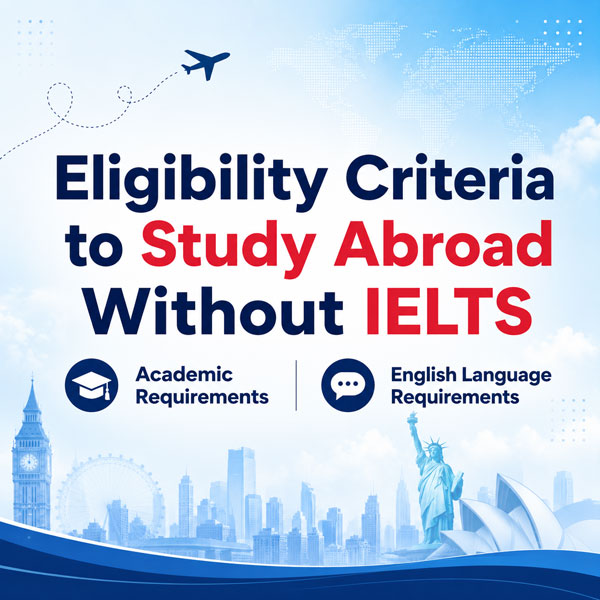
Eligibility Criteria to Study Abroad Without IELTS
Meeting the admission requirements remains one of the most important parts of the application process. Although eligibility varies by country and university, most institutions request similar academic documents.
Preparing every document in advance helps avoid delays during admission.
Academic Requirements
- Completed Class 12 for undergraduate programmes.
- Bachelor’s degree for postgraduate programmes.
- Academic transcripts from recognised institutions.
- Valid passport.
- Recent passport size photographs.
- Statement of Purpose where required.
- Letters of Recommendation for selected courses.
English Language Requirements
Applicants without IELTS may be required to provide one of the following:
- Medium of Instruction certificate.
- TOEFL iBT score.
- PTE Academic score.
- Duolingo English Test score.
- Cambridge English qualification.
- University conducted online interview.
Admission requirements differ between universities. Consequently, reviewing official guidelines before applying helps prevent unnecessary complications.
Documents Required to Study Abroad Without IELTS
Submitting complete documentation improves the chances of receiving an admission offer without unnecessary delays. Therefore, students should organise every required document before starting university applications.
The following documents are commonly requested by international universities.
- Valid passport.
- Academic mark sheets and certificates.
- Official academic transcripts.
- Updated resume for postgraduate programmes.
- Statement of Purpose.
- Letters of Recommendation.
- Medium of Instruction certificate, if accepted.
- Alternative English language test score, if required.
- Portfolio for design or architecture courses.
- Passport size photographs.
Accurate documentation plays an important role throughout the admission process. Students seeking professional guidance can explore application and admission assistance before submitting university applications.
Popular Courses to Study Abroad Without IELTS
Students applying without IELTS can choose from a wide range of programmes across different academic fields. The best option depends on career goals, academic background, and future employment opportunities.
Popular programmes include:
- Business Administration.
- Computer Science.
- Artificial Intelligence.
- Data Science.
- Mechanical Engineering.
- Civil Engineering.
- Information Technology.
- Cybersecurity.
- Healthcare and Nursing.
- Hospitality and Tourism Management.
- Finance and Accounting.
- Digital Marketing.
Selecting the right programme is just as important as selecting the right university. Therefore, comparing course structure, tuition fees, career opportunities, and internship options before making a decision is highly recommended.
Student Visa Requirements for Studying Abroad Without IELTS
Receiving a university admission offer is only one step in the journey. Students must also meet the student visa requirements of their chosen country. Although some universities accept applications without IELTS, visa authorities may still require proof of English proficiency depending on current immigration rules.
Therefore, understanding both university admission policies and visa requirements before applying is essential.
Common visa documents include:
- Valid passport.
- Official university admission letter.
- Proof of financial support.
- Academic transcripts and certificates.
- Statement of Purpose, if required.
- Passport size photographs.
- Medical examination, where applicable.
- Police clearance certificate, if requested.
- Proof of English language proficiency according to visa regulations.
Preparing every document carefully helps reduce delays during visa processing. Students can also benefit from professional visa guidance before submitting their applications.
Scholarships for Students Applying Without IELTS
Many students assume that studying without IELTS limits scholarship opportunities. However, scholarship eligibility usually depends on academic performance, leadership qualities, financial need, or research achievements rather than a specific English language test.
Several universities and government organisations continue to offer financial support to eligible international students.
Popular scholarship options include:
- Chevening Scholarships.
- DAAD Scholarships.
- Australia Awards Scholarships.
- Erasmus Mundus Joint Master’s Scholarships.
- University specific merit scholarships.
- Government funded international education grants.
Applying before scholarship deadlines can improve the chances of receiving financial assistance. Students searching for funding opportunities may also explore scholarship support before submitting university applications.
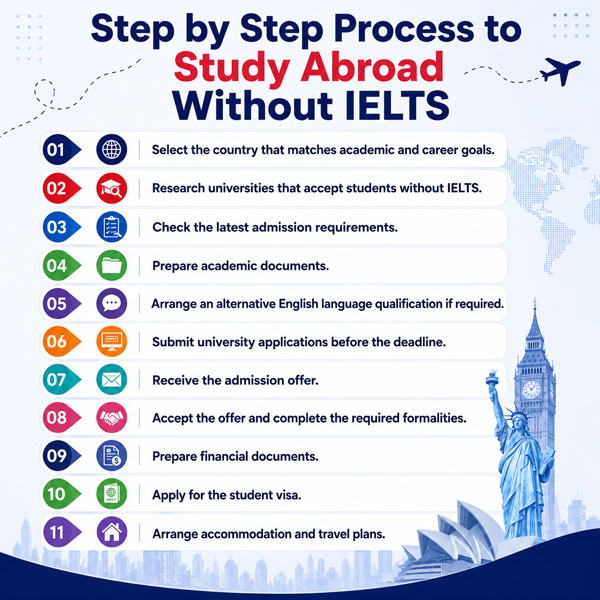
Step by Step Process to Study Abroad Without IELTS
Following a structured approach makes the admission process much easier. Every stage requires careful planning, accurate documentation, and timely applications.
- Select the country that matches academic and career goals.
- Research universities that accept students without IELTS.
- Check the latest admission requirements.
- Prepare academic documents.
- Arrange an alternative English language qualification if required.
- Submit university applications before the deadline.
- Receive the admission offer.
- Accept the offer and complete the required formalities.
- Prepare financial documents.
- Apply for the student visa.
- Arrange accommodation and travel plans.
Students who need support throughout the admission journey can receive personalised assistance for university applications, document preparation, and course selection from Nexa Overseas.
Common Mistakes to Avoid When Applying Without IELTS
Many students miss valuable opportunities because of avoidable mistakes during the admission process. Careful preparation can improve both admission and visa outcomes.
Some common mistakes include:
- Assuming every university accepts applications without IELTS.
- Ignoring university specific admission requirements.
- Submitting incomplete application documents.
- Applying close to the admission deadline.
- Choosing a course without researching career opportunities.
- Ignoring scholarship application deadlines.
- Preparing financial documents at the last minute.
- Not checking student visa requirements before applying.
Starting the application process several months in advance provides enough time to compare universities, prepare documents, apply for scholarships, and complete visa formalities.
Best Countries Based on Career Opportunities
Choosing the right country involves more than selecting a university. Future career opportunities, graduate employment rates, and work permit options also deserve careful consideration.
Canada
Canada continues to attract international graduates because of its strong employment market, post graduation work opportunities, and growing demand for skilled professionals.
Germany
Germany remains one of the leading destinations for engineering, automotive technology, manufacturing, and research based careers. Many graduates also benefit from affordable education and excellent industry connections.
United Kingdom
The United Kingdom offers excellent career prospects across business, finance, healthcare, technology, and creative industries. Graduates also benefit from internationally recognised qualifications.
Australia
Australia provides strong employment opportunities in healthcare, engineering, information technology, education, hospitality, and construction. Graduates often gain valuable international work experience after completing their studies.
Ireland
Ireland has become a preferred destination for students interested in technology, pharmaceuticals, finance, and business. Many multinational companies have established offices there, creating excellent career prospects for graduates.
Why Choose Nexa Overseas?
Planning to study overseas involves several important decisions. Selecting the right university, understanding admission requirements, preparing documents, and completing visa formalities all require careful attention.
Nexa Overseas supports students throughout every stage of the application process. Personalised guidance helps students identify suitable universities, prepare strong applications, and avoid common mistakes before submission.
Students can receive assistance with university and course selection, visa documentation, scholarship opportunities, and admission planning based on individual academic goals.
Conclusion
Choosing to study abroad without IELTS is now a realistic option for many students in 2026. Universities across countries such as Canada, Germany, the United Kingdom, Australia, and Ireland have introduced flexible admission pathways that recognise alternative English language qualifications or previous education completed in English. As a result, students have more opportunities to pursue higher education without limiting their university choices.
Even so, every university follows its own admission policy. Therefore, researching eligibility criteria, preparing accurate documents, and understanding visa requirements remain essential before submitting an application. Planning ahead also provides enough time to apply for scholarships, compare universities, and complete every stage of the admission process with confidence.
Students looking for expert guidance can contact Nexa Overseas for a free consultation. Professional advice can help identify suitable universities, simplify the admission process, and support every step from application to visa approval.
Frequently Asked Questions
1. Can students study abroad without IELTS in 2026?
Yes. Many universities accept international students without IELTS by recognising alternative English language tests, Medium of Instruction certificates, or university interviews. However, admission requirements vary between institutions.
2. Which countries allow students to study abroad without IELTS?
Several countries offer this opportunity, including Canada, Germany, the United Kingdom, Australia, Ireland, Norway, and selected universities in Europe. Each university has its own eligibility criteria.
3. Which English language tests are accepted instead of IELTS?
Many universities accept TOEFL iBT, PTE Academic, Duolingo English Test, Cambridge English Qualifications, and other recognised language assessments depending on their admission policy.
4. Can a Medium of Instruction certificate replace IELTS?
Yes. Some universities accept a Medium of Instruction certificate if previous education was completed in English. Nevertheless, this option is available only at selected institutions.
5. Is a student visa possible without IELTS?
Visa requirements depend on the destination country. While universities may grant admission without IELTS, immigration authorities may still request proof of English proficiency or additional supporting documents.
6. Which country is best for studying abroad without IELTS?
The best destination depends on academic goals, preferred course, tuition budget, career opportunities, and university admission requirements. Canada, Germany, Australia, and the United Kingdom remain popular choices among Indian students.
7. Can scholarships be awarded without an IELTS score?
Yes. Many scholarships focus on academic performance, leadership skills, research achievements, or financial need rather than a specific English language test.
8. What documents are required to study abroad without IELTS?
Most universities request academic transcripts, certificates, a valid passport, Statement of Purpose, Letters of Recommendation, financial documents, and proof of English proficiency according to university requirements.
9. How early should students begin the application process?
Starting the application process at least eight to twelve months before the preferred intake provides enough time for university selection, documentation, scholarship applications, and visa processing.
10. How can Nexa Overseas help students study abroad without IELTS?
Nexa Overseas provides guidance for university selection, admission applications, scholarship opportunities, document preparation, visa assistance, and personalised counselling to help students complete the study abroad process with confidence.

Related Posts

Comments (0)